

Gravity II: The Sequel
All the other things about gravitation

[Posts are sequential, to be read/heard in date order - opposite to the order they’re generally displayed in. Paid-for posts have technical content.]
Please pass a link to these posts to any friend you feel may be interested.
Click the arrow below to hear an audio version of this post (36 mins 10 sec).
So where does gravity actually come from?
Let’s start with a simple thought experiment - one we don’t actually need to do physically.
We’ll imagine two identical asteroids, both static with respect to each other, a very long distance apart. Far enough apart that their gravitational attraction on each other is almost nothing (and there are no other planets, stars or gravitating masses close enough to have any effect). Those asteroids will start moving towards each other, almost imperceptibly at first then faster as they get closer together and their mutual gravitational attraction gets ever stronger. Their behaviour will of course be identical, equal and opposite, as they themselves are identical.
Ok, so by the time they get close to each other they’re both moving very fast, due to that increasing mutual attraction. So, now, a question: conservation of energy tells us that each asteroid has the same total energy as it had to start with (since they’re both identical and there’s been no energy input or output) but each asteroid now has a substantial amount of kinetic energy; so where did that come from, since neither asteroid appears to have got smaller, or lost mass-related energy in some other way? That mass-related energy, the E = mc squared stuff, was all they each had initially. Where did that extra kinetic energy magically appear from??
Ok, we’ll now take our thought experiment a step further. We’ll imagine a humungous sized spring of negligible mass hanging in space midway between those two asteroids. It acts like a giant brake, slowing those two asteroids as it’s compressed between them, so that they both come to a halt a short distance apart. We now have two asteroids, static as they were to start with - but now with a compressed spring holding all that energy they built up as kinetic energy on their way towards each other.
Since final energy = initial energy, and final energy now includes that very substantial energy held in a compressed spring, it’s clear that the energy content of each asteroid is now considerably less than it was at the start - even though those asteroids don’t appear to have changed physically in any way.
What we’re seeing here is gravitational negative energy: an object held in the gravitational field of a large mass (as each of these asteroids now is) has less structural energy than it does when it’s free of gravitational fields (as they were at the start).
So how can that be? For a clue on this we need to look at how a laser works. The SER in LASER stands for “Stimulated Emission of Radiation”: if an atom is in an excited state, holding one of its electrons at a higher energy level than its base state, a passing photon can stimulate the excited electron to drop back to its base state and release that excitation energy, if the passing photon is of the right energy to prompt such an action.
In simple terms, the time-varying electromagnetic fields of the passing photon interfere constructively with the electromagnetic structure of the atom to give a momentary impression of an excess of energy. So the atom releases that excess - it drops the electron down to its base state and emits a photon of energy.
Now let’s get back to those asteroids: each asteroid is bathed in the extended time-varying electromagnetic fields of the matter-particles of the other. This prompts the receiving asteroid to experience an apparent excess of electromagnetic field effects, aka energy (just like in that laser, but long-term, not just fleetingly from a passing photon) - so it releases some of its structural energy as energy of motion, without compromising its structural integrity.
It’s maybe easier to consider a smaller object - say a pebble dropped from the Leaning Tower of Pisa. The pebble is bathed in the time-varying electromagnetic field effects emanating from the particles of our planet. It experiences an apparent excess of structural energy - so it releases that excess as energy of motion (acting preferentially downwards, for reasons we’ll discuss shortly). It can then exist in a stable state with that reduced energy, as its structural energy is being augmented by those extended field effects of the planet that’s attracting it. When the pebble hits the ground - assuming it doesn’t shatter - it will then release its kinetic energy as sound, heat, maybe compression of the surface, and exist as a stable static pebble with reduced energy: original energy less that negative gravitational energy. To get it back up to the top of the Tower of Pisa would take a positive input of energy to counteract that loss in energy, that negative energy, resulting from that loss in height.
In the same way, each of those asteroids receives structural support for their formative energy-flows from the ‘gravitational field’ of the other, allowing - indeed, forcing - each to transmute some of its structural energy into energy of motion.
[Those two asteroids could of course be returned to their original state by reinstating their full structural energy at the same time as moving each out of the ‘gravitational field’ of the other. This could be done by simply allowing that spring to re-expand, releasing its compressed-spring energy content back into the asteroids. They would each accelerate as the spring expanded to its full length, then the ever-diminishing effect of gravity would slow them at an ever-decreasing rate as their energy of motion was re-absorbed as energy of structure (as the structural support given by the other asteroid’s field in each case would steadily diminish with distance). Ultimately they would come to a halt at the same distance apart as they first started, if the spring was 100% efficient.
. . . Then, presumably, the whole cycle would start again. . . ]
In this we see included the idea of escape velocity: the hypothetical spring gives each asteroid [almost] enough speed to escape completely from the clutches of the other’s gravitational field. In simple terms, it’s theoretically possible (though unlikely in practice) to give an object on Earth an upward velocity at ground zero sufficient for it to escape from the Earth’s gravitational field: the transfer of energy from kinetic to structural would slow the object as it moved away. Ignoring air resistance, escape velocity from Earth is around 11.2 kilometres per second; this means that (if there were no atmosphere) a projectile such as a bullet fired vertically upwards at that speed would be slowed by our planet’s gravitational pull at an ever-decreasing rate as that pull itself steadily diminished, to the extent that it could never stop that bullet’s motion or pull it back to the Earth; the projectile would, at least in theory, reduce its speed to zero at an infinite distance from Earth, where the planet’s influence on it would also reduce to zero.
When we talk about ‘gravitational pull’, we are of course referring to the effect of the extended electromagnetic field of a gravitating body - Earth in this case - on the electromagnetic energy structure of the affected object - the bullet in this case. Time now to get some detail on the workings of that process.
How it works: Electrostatics and Gravitation
We can’t say for certain at present which of the two circular polarisation states in the formative photons of a particle gives rise to which electric charge as an extended effect. This may well become apparent in the future, but it’s of no real consequence for this discussion. So for the time being we’ll simply use N for the polarisation state producing a negative charge effect and P for the one producing a positive charge effect as an artefact of a particle’s structure - this leads to no loss of generalisation in this description of mechanisms of attraction and repulsion.
[Note that Right and Left circular polarisation states are not symmetric: juxtaposition of electric and magnetic field components are not symmetrically oriented. It’s clear from experimental evidence that this asymmetry leads to like polarisation states causing enhancement of the outward-facing side of an affected particle whereas unlike polarisation states lead to enhancement on the inward-facing side. The significance of this should become clear in the next few paragraphs.]
So let’s envisage a large positively-charged mass. This will inevitably be composed of a mix of P- and N-type cyclic-photon elements, but the P-type will predominate. So this mass will be surrounded by a ‘cloud’ of time-varying electromagnetic field effects, extending without limit, giving rise to the phenomenon referred to as ‘positive charge’.
[These field effects are conventionally referred to as ‘virtual photons’.]
Now let’s mentally place a small particle, say an electron, wholly composed of N-type cyclic-photon waveform energy, close to this positively-charged mass. The positive-effect ‘virtual photon’ electromagnetic time-varying field effect from the large mass interferes with the structure of this particle, preferentially on its nearer side (due to the magnetic field components of the two being oppositely orientated); this results in the energetic structure of the electron being enhanced in the direction of the large mass, giving it a component of motion in that direction. This brings it closer to the mass, successively increasing this effect. The ‘virtual photon’ field supports the energetic structure of the electron, allowing - or even forcing - it to convert some of its innate structural energy to energy of motion.
If instead of an electron we place a proton - a positively charged hydrogen nucleus - close to that large mass, the mass’s ‘virtual photon’ positive influence field instead enhances the structure of that positively-charged particle on its outward facing side (due to the magnetic field components of both being oriented in the same sense). This has the effect of inducing a component of motion away from the large mass. As the proton moves away, that effect diminishes; its structure is no longer so augmented or extended in the outward direction, so the proton is repelled less forcibly and also needs more of its own innate energy to maintain its structure: it progressively slows down.
From this we see how electrostatic charge, with its attractive and repulsive effects, is a natural consequence of the cyclic-photon structure of matter. We also see how those two effects could - indeed, almost certainly would - differ to a miniscule degree due to their tiny difference in distance of action: the width of the affected particle.
This takes us straight back to the subject of gravitation. So how would this all fit in with causal mechanisms for gravity?
Well, right off the bat we have a very plausible reason for the proposed marginal difference between forces of attraction between unlike charges and forces of repulsion between like charges. If we then apply that to every thread of energy-flow forming two particles each with a net charge of zero - so equal amounts of Left and Right polarised photon energy in each case - we’ll get precisely the situation described in the previous post on gravitation: every thread of energy in one particle will enhance unlike energy-threads in the other particle towards it and like threads in that other particle away from it (Note that we’re referring here to the total energy content, and so the total mass, of each particle). Since each particle, being neutral overall, has equal measures of each type of polarisation, the effects will be split fifty-fifty between attraction and repulsion - except that each element of attraction is just that tiny bit stronger than each element of repulsion. This gives us a factor of a trillionth of a trillionth of a trillionth in favour of the attracting influence.
Welcome to the Gravitational Field
So that gives us a picture of the gravitational effect between two objects, or two masses (such as those two asteroids, for instance). But how does that take us to the curvature of spacetime business?
Maybe a few diagrams would help.
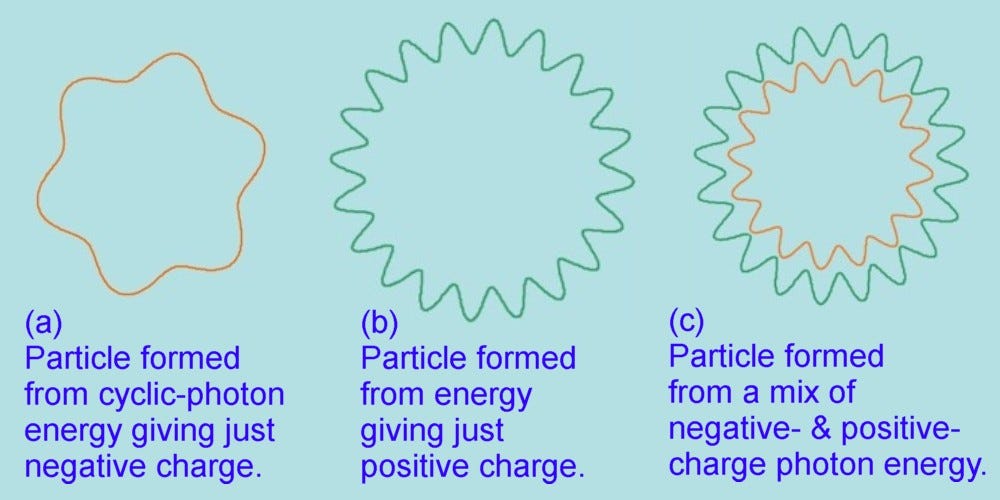
Each of these pictures represents a particle with the frequency per cycle as shown.
So (a) represents a particle with an energy frequency of 6, all giving negative charge effect in the extended field of that particle.
(b) represents a particle with energy frequency of 20, all contributing to positive charge on that particle.
So each of these has a charge that’s proportional to its full energy content - and so also proportional to its mass.
(c), though, represents a particle with a mix of negative- and positive-charge energy content, with frequency components of 16 and 20 respectively. The total energy content, and so also the total mass, is represented by a frequency of 20 + 16 = 36; that’s six times the mass/energy of particle (a). But its effective net charge is the difference between those two charge contributions - a net charge proportional to a frequency of just 4 (in the positive sense, in this case). So we see how a particle with six times the mass of another can have an effective charge just two-thirds that of the smaller particle.
But let’s consider the extended effect of particle (c) on the volume of space around it. That 16-frequency negative-charge structural component will generate an extended field of that strength carrying a negative-charge effect out into space without limit, though diminishing with distance. The 20-frequency positive-charge component will likewise carry that strength of positive-charge effect outward without limit. These effects will combine with similar effects from every other material particle in the cosmos to give a composite field of negative and positive charge effects.
If like effects and unlike effects had equal magnitudes, per unit charge, of repulsion and attraction then we could simply cancel those opposing charge effects down to a total of plus four. But it doesn’t quite work like that.
Consider, for example, two identical particles each with a net charge of zero: a frequency component of 16 in the positive-charge sense and 16 in the negative-charge sense, in each case. We’ll take green to represent positive-charge components and orange for negative-charge components, as before.
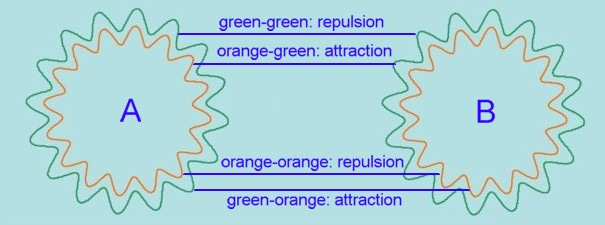
If we just consider A’s effect on B:
The green component in A repels the green component in B, but attracts the orange component in B. The orange component in A attracts the green component in B but repels the orange component in B.
Since the strength of attraction or repulsion, for each particle, is proportional to the frequency component of both influencer and influenced in each case, we have:
Total attracting influence = green x orange + orange x green = 2 x 16 x 16 = 512
Total repelling influence = green x green + orange x orange = 2 x 16 x 16 = 512
[B’s effect on A will of course be equal, in the opposite direction.]
So we have equal measures of attractive-influence elements and repulsive-influence elements. If those opposing elements were precisely equal in their effect then the overall consequence would be a zero net effect. But we’ve seen that the attractive effect acts on the inward-facing - closer - side of the affected particle, whereas the repulsive effect acts on the outward-facing - further - side. This tiny difference in distance leads to a tiny difference in magnitudes of those two opposing effects, with a very slight advantage in the attracting sense. This leads to a marginal degree of attraction, even between two apparently electrically neutral particles: gravitation.
[Note that sizes and distances in this diagram are highly disproportionate: it wouldn’t be possible to clearly represent these relationships if they were drawn to scale.]
Now if we put all that together, for every material particle in the universe, we get:
Curvature of Spacetime
Just envisage every particle of matter having around it, extending infinitely in every direction (reducing in strength with distance), electromagnetic field effects from both right and left circularly polarised photons which together form the structure of those particles. This makes the whole of the cosmos a vast ocean of intermingled positive and negative charge effects, both present at every point in space (and not cancelling each other out).
This next picture shows in diagrammatic form a tiny fragment of space in which a particle is immersed in this ocean. You’ll see that the particle is electrostatically neutral, being composed of an equal measure of right and left circularly polarised photon energy; also that the surrounding space has an equal balance of positive and negative charge influences.
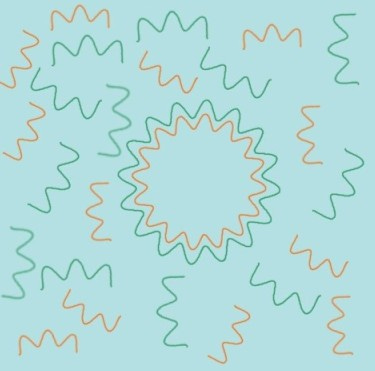
Let’s imagine that the particle is part of a satellite orbiting Earth. The space surrounding it will contain predominantly charge influences emanating from the matter of the planet (because they’re closest). If you look carefully you’ll see that those influences are bunched slightly more closely in the upper left of the picture; this tells us that Earth is in that direction relative to the satellite (again, exaggerated for illustration purposes).
Those influences in every direction will give rise to proportional changes in the energetic structure of the particle, translating into attractions and repulsions from all directions. Those effects will be stronger in the upper left direction - towards Earth - and for reasons we’ve already discussed the attractive influence will very slightly exceed the repulsive influence: the satellite will experience an element of attraction towards Earth.
We could put it slightly differently: those influences in every direction effectively create humps and dips in the ‘landscape’ of space, which will vary dynamically with time as the planet and other heavenly bodies follow their respective courses through space. A dip is a point of combined positive and negative charge effects, equal in measure, giving an overall downward - i.e. attractive - tendency. If we envisage the highest level in that ‘landscape’ as any point where there is no such charge influence of either type, then the greater the degree of influence the lower the dip. Such effects will be most pronounced around large massive bodies - those 'gravity wells’ that General Relativity refers to.
The whole of space is, then, an undulating energy-scape through which all material objects manoeuvre their paths - including those massive bodies which themselves sculpt that energy-scape in its ever-changing form. Equal measures of positive and negative influences, which will be the case everywhere except small pockets around charged objects, combine to form the unbroken fabric of that energetic space-scape and so give rise to the effect referred to as curvature of spacetime. The energetic structure of material objects draws them to follow those contours in concert with their own innate velocities, like cosmic bobsleigh riders. In the case of the satellite, that particular bobsleigh is balancing its own velocity against the downward ‘slope’ of the Earth’s extended electromagnetic influence like a wall of death rider.
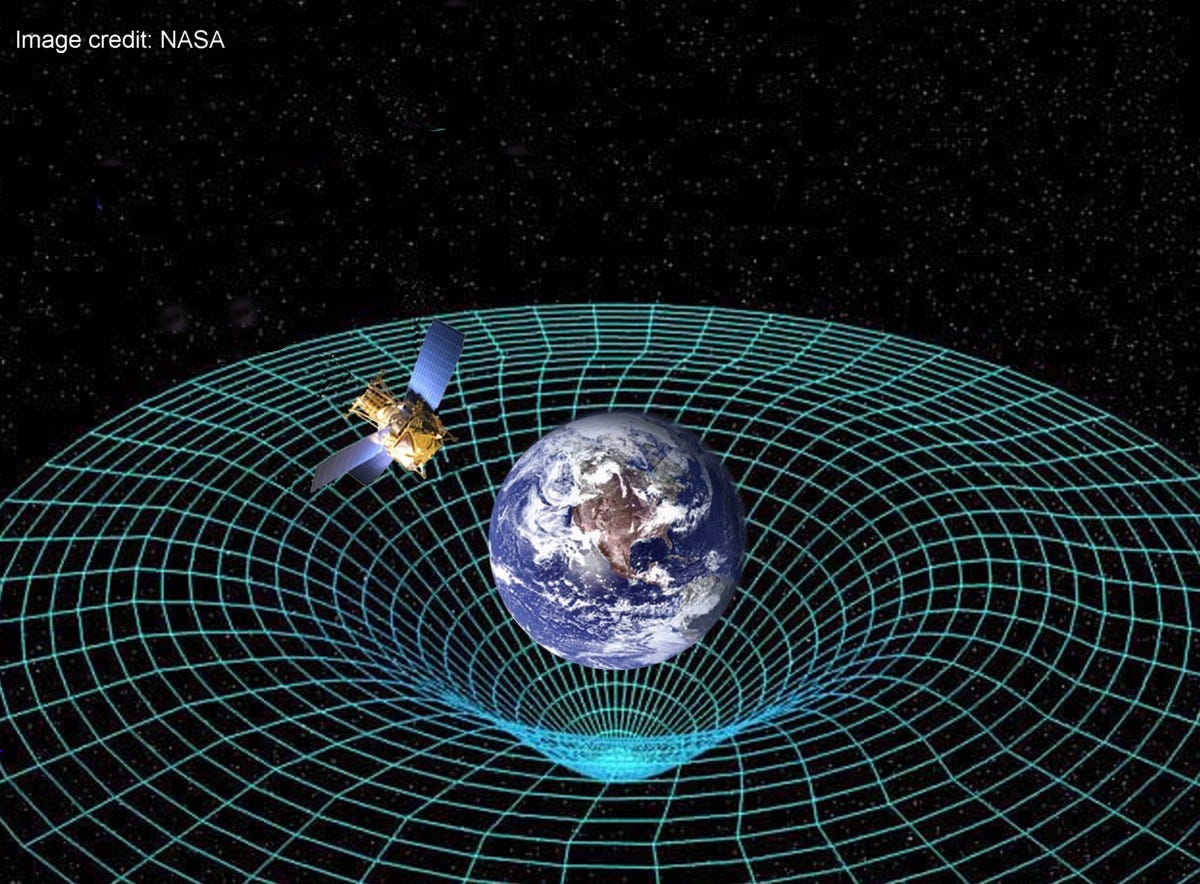
[Note that representation of an additional dimension - texture/curvature of space - in this already 3D setup (shown in 2D) is necessarily limited (how does one show the focus of the ‘gravity well’ as being ON the Earth’s surface directly below the satellite, rather than below the Earth?), but as a snapshot in time (yet another dimension) it hopefully gets the idea across.]
The Equivalence Principle: Gravity or Acceleration?
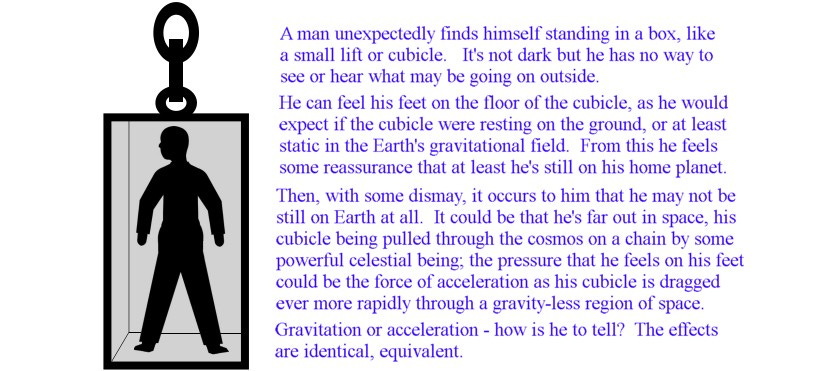
He takes a ball out of his pocket and throws it up into the air. It goes up a short way, slowing down, than falls back with increasing speed to land on the floor and bounce - just as he’d expect on Earth. Ah, what a relief! Then he realises this is exactly what would happen if he were accelerating through a zero-g region of outer space: the ball wouldn’t slow down or fall back - but his cubicle would catch up with it then overtake it, so it would seem to fall; that bounce could actually be the now faster-moving cubicle hitting the slower-moving ball, just like a batsman hitting a cricket ball.
Then he sees a pinhole beam of light coming through a tiny transparent area near the top of his cubicle. Ah, a ray of hope! Like all good scientists he has a pocket toolkit of high-precision instruments (in his pocket); by careful measurement he finds that the beam of light is curving ever-so-slightly downward. Dismay! This is exactly what he’d see if he were accelerating through space, accelerating away from an actually-straight beam of light.
Just then the ghost of Einstein taps him on the shoulder and murmurs: “Dear boy, that’s exactly how it would be if you were static in the Earth’s gravitational field. My Equivalence Principle says that experience in a gravitational field is identical to that in a state of acceleration - so light curves in a gravitational field, too”.
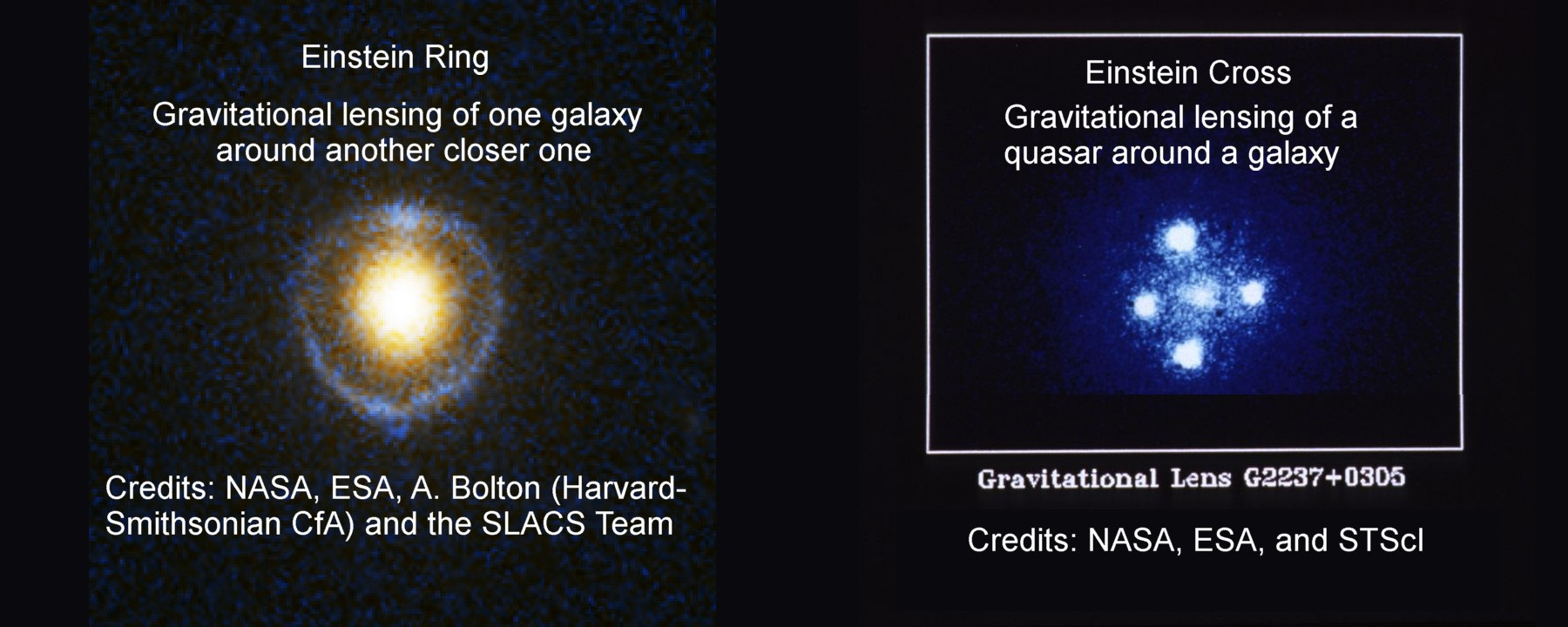
And so it is. Light is bent by the effect of gravitation - an effect intuited by Einstein through (correctly) equating gravitational effects with effects of acceleration. This was first proved in 1919 by observation of a star that should have been hidden behind the sun: the star’s light was bent around the sun by the sun’s gravitational field and appeared beside the sun, whilst the sun itself was blacked out by an eclipse. Since then there have been countless sightings of gravitational lensing, including numerous Einstein crosses and Einstein rings, where multiple images have been bent around a star or a galaxy to appear in several places around it, or even as a complete circular image around the gravitating mass.
So how does this happen? How is light bent by gravity?
That’s actually quite simple. We’ve seen how that satellite is accelerated towards Earth by the planet’s gravitation, holding it in its orbit - circular motion is caused by constant acceleration towards the centre of the circle. The extended energy-fields of Earth’s particle-waves, aka Earth’s gravitational field, enhance the matter-waves of the satellite’s particles in the direction of Earth, just as a physical force such as a booster rocket would impart directed energy to the satellite’s particle-waves and give them a component of motion towards Earth. In exactly the same way, those extended particle-waves from a large massive body - such as a star or galaxy - enhance the electromagnetic waves of light preferentially in that direction, effectively accelerating that light towards that massive body and so turning its straight-line motion into a curved motion - just like that satellite.
An observer held static in a gravitational field - such as our man in the cubicle - might see light curving in this way and conclude that they are themself accelerating, when in fact it’s the light accelerating in the opposite direction: if A is accelerating relative to B then the visual impression is identical to when B is accelerating relative to A in the opposite direction.
And that’s the whole story of the Equivalence Principle. Gravitation imparts a component of acceleration to both matter and light, in the direction of the massive gravitating body. With no external visual frame of reference, to the observer this is indistiguishable from they themself being in a state of acceleration: being static in a gravitational field is equivalent, in terms of effects, to being in a state of acceleration.
Speed of Light. Black Holes
It’s a well-established fact that light moves more slowly in a gravitational field; the stronger the field, the greater the degree of retardation. Why might this be?
For this we need to go right back to James Clerk Maxwell’s discovery that light is an electromagnetic phenomenon. He made this discovery by deducing that there was a periodic solution to his equations governing electromagnetic fields - and that periodic solution was a wave travelling through space at precisely the speed of light.
His calculation of that speed, which we now refer to as c, was based on the electrical permittivity and magnetic permeability of free space, two well-known constants.
So far, so good. But now we need to recognise that the space around a gravitating mass isn’t totally ‘free’, in an electromagnetic sense. It’s suffused with the extended time-varying electromagnetic field effects emanating from the matter-waves of all the material particles in that gravitating mass. This significantly affects the permittivity and permeability of that region of space: as these increase, as they will with increased density of those field effects, then the speed of light through that region decreases.
Hence the slowing of light in a gravitational field. In the extreme case of a Black Hole, where those constants increase to infinity, the speed of light (being dependent on the inverse of both of them) reduces to zero.
Which takes us on neatly to . . .
Gravitational Time Dilation
Those of you who’ve studied earlier posts on this channel will be well aware that time is propagated across the universe by the time-varying electromagnetic flows - photons - that both form particles and provide the links between them. It follows totally logically that if those flows are slowed down then the passage of time will likewise slow down.
We’ve just seen how the electromagnetic influences we refer to as the gravitational field do indeed slow down the passage of electromagnetic waves, in proportion to the strength of that field. So it is that time slows down in a gravitational field, in line with the strength of that field.
That’s all there is to it really.
Next up:
Photons: Our Passport to the Stars.
A mind-blowing insight into the true nature of Material Reality
In the meantime, be sure to check out Transfinite Mind for a wealth of free resources, including non-technical articles and presentations, as well as books to suit every level of scientific (or non-scientific) background.
Also, if you find these articles interesting and thought-provoking, and you know others who may find them of interest, please be sure to point those others in this direction. Thanks.